
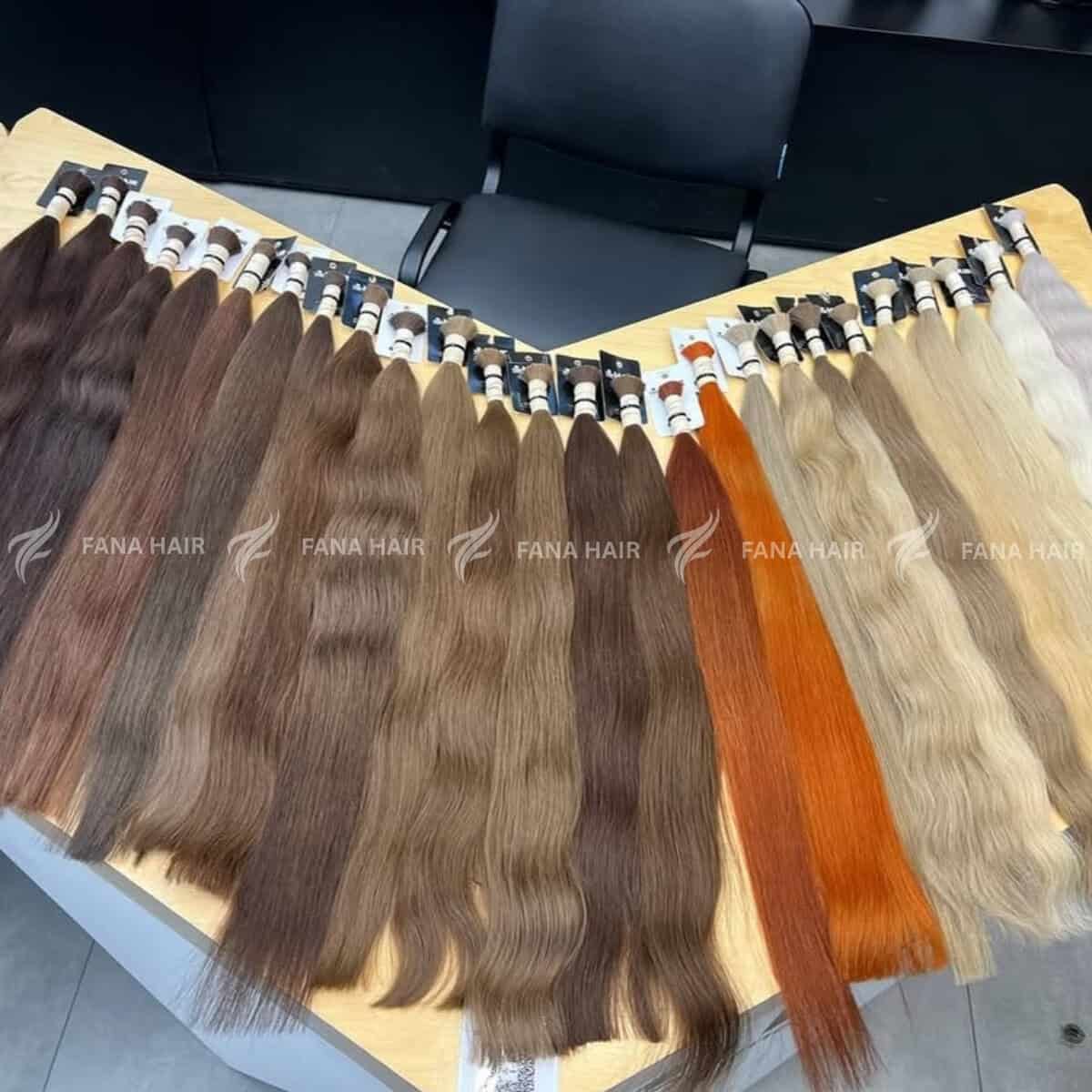
As an extension specialist, you can have the highest quality hair and the most flawless application technique, but if the color is off, the entire illusion is shattered. A bad color match is the number one giveaway that a client is wearing extensions.
Mastering the art of color matching is what separates a good stylist from a great one.
It all starts with understanding the universal language of extension colors: the numbering system. This system is your map. Once you know how to read it, you can confidently select the perfect shade, or combination of shades, for any client.
Let’s decode the color chart and then dive into the professional techniques for a seamless match every time.
Part 1: Decoding the Hair Extension Color System
The numbers on a color ring are not random. They represent a specific level (darkness to lightness) and tone (warmth or coolness). While some brands have slight variations, this is the universal system.
The Basics: Solid Colors (Levels)
These are the foundational, single-pigment colors.
- 1: Jet Black (often with a blue/cool undertone)
- 1B: Off-Black (a “natural black,” often with a slight brown undertone)
- 2: Darkest Brown (looks black, but has a warm, brown base)
- 4: Dark Brown (a classic, rich chocolate brown)
- 6: Medium Brown (a neutral, chestnut brown)
- 8: Light Brown
- 10: Lightest Ash Brown / Darkest Blonde
The Blondes
This is where tones become critical.
- 12: Light Golden Brown / Dark Honey Blonde
- 16: Ash Blonde (a dark, “dirty” blonde with cool tones)
- 22: Medium Blonde (a neutral, wheat-like blonde)
- 24: Light Golden Blonde
- 60: Platinum Blonde (a “white” blonde, very little yellow)
- 613: Light Bleach Blonde (the classic, “Barbie” blonde with yellow undertones)
The Reds & Auburns
- 30: Medium Auburn (a warm, coppery brown)
- 33: Dark Auburn (a deep, rich red-brown)
- 99J / “Burgundy”: A deep, violet-red wine color
Part 2: Understanding Mixed, Rooted, and Ombre Codes
This is where it gets more complex. Once you understand the base numbers, you can read these “combination” codes.
- Mixed/Piano Colors (e.g., P4/27 or 18/22):
- “P” (Piano) or “M” (Mixed) means the colors are in distinct, alternating stripes, like keys on a piano. (e.g., P4/27 is distinct stripes of #4 Dark Brown and #27 Honey Blonde).
- “/” or “-” (Mixed) often means the colors are blended more finely. (e.g., 18/22 is a blend of Ash Blonde and Medium Blonde for a multi-tonal, “highlighted” look).
- Rooted/Ombre/Balayage Colors (e.g., T4/27 or R8/60):
- “T” (Tipped), “O” (Ombre), or “R” (Rooted) means the top (root) of the weft is one color, which transitions to another color at the ends.
- The first number is the root color. The second number is the end color.
- (e.g., T4/27 = A #4 Dark Brown root that fades into a #27 Honey Blonde).
- (e.g., R8/60 = A #8 Light Brown root that “shadows” into a #60 Platinum Blonde).
Part 3: The Art of a Perfect Color Match (Pro Techniques)
Now that you can read the map, here is how you use it.
1. The Consultation is Everything
Never, ever match hair from a photograph. A client’s phone screen, or your phone screen, will distort the color. The client must be in your chair.
2. Use a Professional Color Ring
This is your single most important tool. A color ring (or “color swatch”) from your hair supplier (like FANA Hair) is the only way to guarantee the color you order is the color you get. Do not use a different brand’s color ring, as the “Level 6” from one company may be slightly different from another.
3. Match in Natural Light
This is a non-negotiable rule. Salon lighting is often warm and yellow, which will completely change the hair’s appearance. Take your client and your color ring and stand next to a large window. Natural daylight is the only light that reveals all the undertones.
4. Where to Match: Mid-Lengths and Ends
This is the mistake most new stylists make. Do NOT match the hair to the root.
The root is almost always the client’s darkest, natural color (their “regrowth”). The extensions are not being placed at the root; they are being placed under it. The hair that needs to blend is the hair from the mid-shaft down.
- Hold the color ring at the client’s mid-lengths and ends. This is the hair the extensions must seamlessly blend into.
- The “Rule of 3”: The root, the mid-shaft, and the ends are often 3 different colors. Match the extensions to the majority of the hair, which is almost always the mid-lengths and ends.
5. When in Doubt, Go Slightly Lighter
If you are truly stuck between two shades, it’s almost always safer to go one half-shade lighter than the client’s natural hair. Why?
- Lighter extensions will look like natural highlights and add dimension.
- Darker extensions will look like a “patch” and will be glaringly obvious.
6. The Ultimate Pro-Move: Blending Multiple Shades
This is the secret to a truly invisible, high-end result. Almost no one’s hair is one single, flat color.
Natural hair has dimension, subtle highlights, and lowlights.
- Pick the dominant shade you matched to the ends.
- Pick a secondary shade that is slightly lighter to mimic natural highlights.
- Pick a third shade that is slightly darker (like their mid-shaft color) to add depth.
By custom-blending 2-3 different (but similar) shades during your application—whether you’re using tapes, fusions, or wefts—you create a multi-dimensional, perfectly integrated result that looks 100% natural. This is how you create “million-dollar hair.”
Leave a Reply