
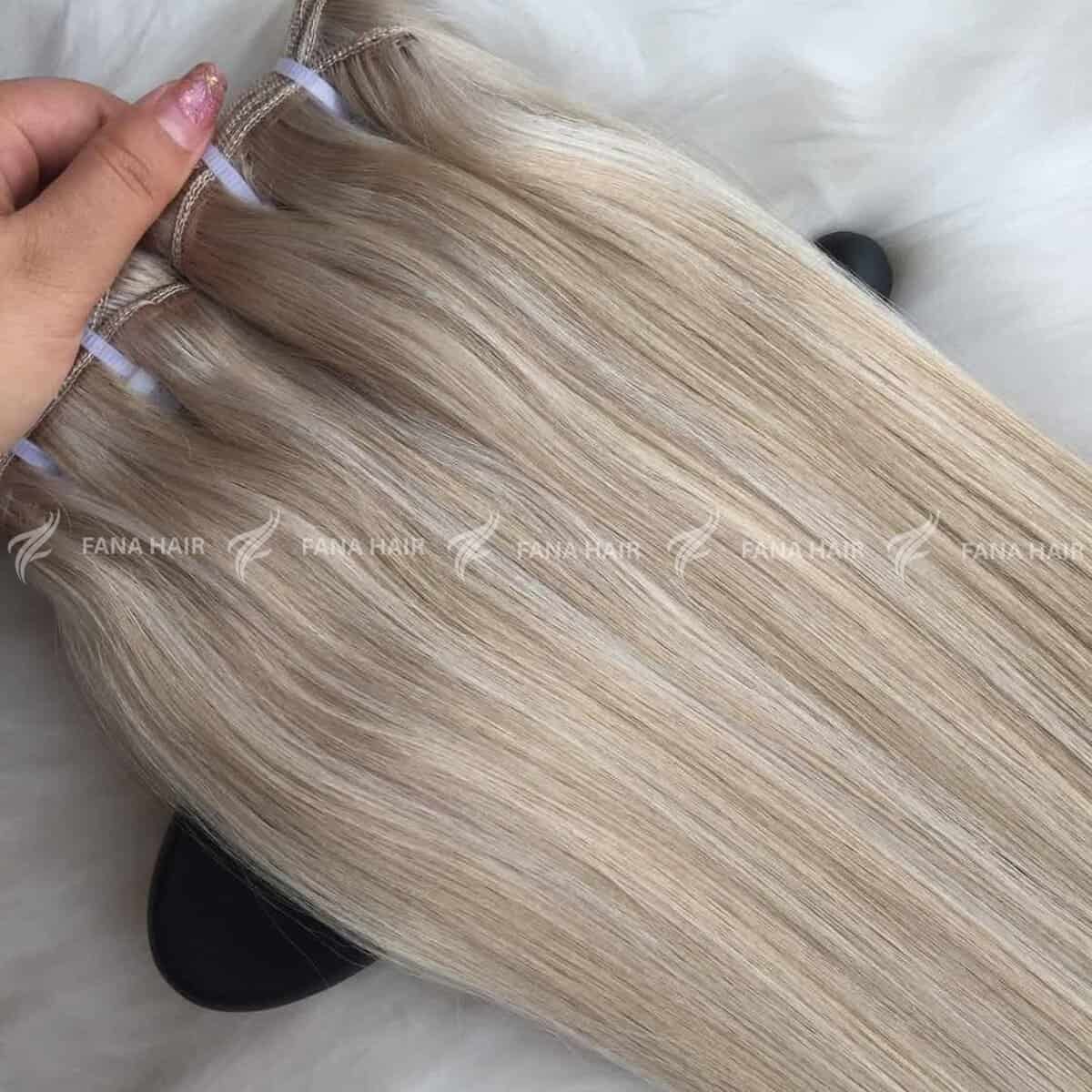
As stylists, we see many clients who dream of thicker, fuller hair. But we also have the “good problem” client: the one who walks in with a naturally thick, strong, high-density head of hair.
This client isn’t looking for volume—they already have it. They are almost always looking for length.
This presents a unique challenge. How do you add 20+ inches of hair to an already-dense head without it looking…
- “Stringy”? The extensions must be as dense as their natural hair.
- Bulky? They already have a lot of hair; a clumsy method will create an unnatural “helmet” look.
- Unsafe? Adding that much hair is heavy. The method must be ableto support the weight without causing damage.
For this client, lightweight, fine-haired methods like tapes or nano-rings are often the wrong choice. You need a powerhouse method designed for high density and durability.
Here are the ideal extension methods for clients blessed with thick, strong hair.
The Weft-Based Solution: Density for Density
The core principle for thick-haired clients is density for density. You need a method that efficiently packs a lot of hair onto the head. The clear winners are weft-based methods.
A “weft” (a curtain of hair) delivers maximum density in a way that strand-by-strand methods can’t match for efficiency. Here are the two top contenders.
1. The Traditional Sew-In (The Classic Powerhouse)
This is the original, time-tested solution for adding length and fullness to thick, coarse, or textured hair. It involves sewing hair wefts onto a secure, braided (cornrow) foundation.
- Why It’s Ideal for Thick Hair:
- Unmatched Strength: The braided foundation is the strongest “anchor” you can create. It’s designed to support the weight of multiple, heavy wefts (200g, 300g, or more) without putting stress on individual strands.
- Full Coverage: It provides complete coverage, making it easy to blend the client’s thick hair and the dense extension hair.
- Protective Style: This is a huge bonus. The client’s natural hair is braided away, protecting it from daily heat styling and manipulation.
- Best For:
- The client with coarse or highly-textured hair.
- The client who wants a true “protective style.”
- The client who prioritizes maximum durability and security.
2. The Beaded Weft (The Modern Solution)
This is the modern, braidless evolution of the sew-in. Instead of a braid, you create a “track” foundation using silicone-lined micro-beads and the client’s natural hair. The wefts are then sewn onto this bead track.
- Why It’s Ideal for Thick Hair:
- Density Without the Bulk: You get all the high-volume benefits of a weft, but without the bulk of the braids. The wefts lay much flatter to the head.
- Scalp Health & Comfort: The scalp can “breathe.” It’s far easier for the client to wash and—more importantly—dry their scalp, which is a huge plus for thick-haired clients.
- Strong & Stackable: The bead track is extremely secure. You can easily “stack” 2, 3, or even 4 wefts (especially thin hand-tied wefts) onto a single row to perfectly match the client’s natural density.
- Best For:
- The client with thick, straight or wavy hair.
- The client who wants a flatter profile and more scalp comfort.
- The client who wants an easier maintenance and “move-up” process.
The Luxury Option: Keratin (Hot Fusion)
What if your thick-haired client wants 360-degree movement for high, sleek ponytails? A weft-based method might not be flexible enough. In this case, you can offer a strand-by-strand method, but with a major disclaimer.
- Why It Works: Keratin bonds are durable, long-lasting (3-5 months), and offer the most natural movement. The bonds are discreet and can handle the weight if applied correctly (one-to-one density).
- The Catch: Time & Cost. This is the crucial part of the consultation. A full head of extensions on average hair is 100-150 strands. A full head on thick hair will require 150-250+ strands. This is not a 2-hour service; it is a 4- to 6-hour (or longer) luxury application. The client must have the budget and the patience for it.
- Best For:
- The client with an unlimited budget and schedule who demands the ultimate in discretion and styling flexibility.
The Method to (Probably) Avoid: Tape-Ins
While tape-ins are fantastic for fine-to-medium hair, they are often a poor choice for high-density hair.
- Why It’s Not Ideal: To match the client’s natural density, you would need to install an enormous number of tape “sandwiches” (e.g., 30-40+ pairs).
- This many tabs becomes bulky and heavy.
- It creates too many seams, which can be difficult to hide and can slip under the combined weight.
- It’s just not an efficient or discreet way to add length to already-thick hair.
The Final Verdict
For the client with a strong, healthy, and thick head of hair, weft-based methods are the “ideal” solution.
They are strong, efficient, and designed to deliver the high-density blend this client needs. The choice between a Traditional Sew-In and a Beaded Weft comes down to their secondary priority: scalp comfort (Beaded Weft) vs. ultimate protection (Traditional Sew-In).
Leave a Reply